Introduction: A Strategic Gateway in the Gulf of Guinea
Located in Central Africa at the heart of the Gulf of Guinea, the Port of Douala is more than a maritime facility — it is the primary gateway through which Cameroon connects to global markets. For decades, it has served as the backbone of the country’s import and export ecosystem, linking domestic industry with Europe, the Middle East, Asia, and neighbouring African economies.
Its strategic geographic position allows Cameroon to function not only as a coastal nation, but also as a regional logistics bridge for landlocked countries such as Chad and the Central African Republic. In this sense, Douala is not simply a national port — it is a regional trade artery.
The Economic Significance of the Port
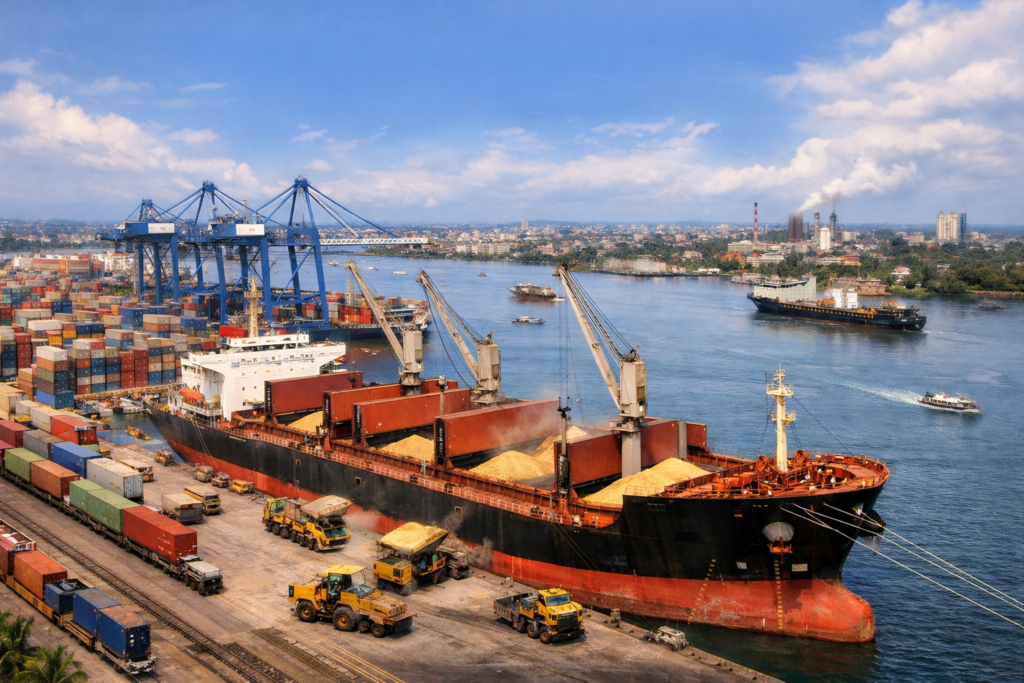
The Port of Douala handles the overwhelming majority of Cameroon’s maritime trade. From containerized cargo to bulk commodities, petroleum products, timber, and industrial raw materials, the port facilitates the movement of goods that underpin construction, manufacturing, agriculture, and energy production.
Key sectors supported by the port include:
• Cement production and construction materials
• Agricultural exports such as cocoa and timber
• Petroleum and energy logistics
• Emerging mineral exports including bauxite
As Cameroon continues to urbanize and industrialize, demand for infrastructure materials — particularly cement — is rising steadily. This alone places increasing pressure on port throughput capacity.
At the same time, mineral development projects are gaining momentum, with projected bauxite exports expected to grow significantly in the coming years. These trends signal a structural shift: the Port of Douala must evolve to handle higher cargo volumes more efficiently.
Growth Amid Structural Constraints
While trade volumes have grown, the port faces structural and nautical limitations that affect performance.
The Douala access channel is long and narrow, with draft limitations that restrict the size of vessels that can navigate safely to the inner port. Larger vessels are constrained by tidal windows, and draft depth must be maintained through regular dredging operations.
These conditions create operational realities:
• Vessel waiting times at anchorage
• Increased shipping costs
• Limited ability to handle larger, more cost-efficient bulk carriers
• Congestion during peak periods
For an economy seeking to increase export competitiveness and reduce import costs, these constraints matter.
Modernization and Investment
Recognizing the importance of maritime trade, Cameroon has embarked on modernization initiatives aimed at improving port infrastructure, operational systems, and security frameworks.
These efforts include:
• Infrastructure upgrades
• Enhanced port management systems
• Security and compliance improvements
• Capacity expansion initiatives
Modernization is not optional — it is necessary for Cameroon to remain competitive in global trade networks.
However, infrastructure upgrades alone cannot fully resolve channel depth limitations. This is where operational innovation becomes essential.
The Strategic Role of Offshore Logistics
To complement modernization efforts, offshore transshipment and deep-water anchorage operations provide a practical solution to draft constraints.
By leveraging deeper waters available offshore, larger vessels such as Panamax and Capesize carriers can discharge or receive cargo without navigating the constrained inner channel. Cargo can then be transferred using barges and floating cranes between offshore vessels and shore facilities.
This approach:
• Reduces vessel waiting time
• Improves cargo handling efficiency
• Allows handling of higher volumes
• Supports large-scale mineral exports
• Enhances overall supply chain reliability
In effect, offshore logistics expands the functional capacity of the port without requiring immediate large-scale channel reconstruction.
Regional Impact and Industrial Development
A more efficient Port of Douala has multiplier effects across the national economy.
Improved logistics performance:
• Reduces cost of imported raw materials
• Strengthens domestic manufacturing competitiveness
• Enhances export potential
• Encourages foreign direct investment
• Supports regional trade integration
For landlocked neighbours relying on Douala as their maritime outlet, improved performance also reduces trade friction and transport costs.
In a region where logistics inefficiencies can significantly impact GDP growth, port optimization is not just a maritime issue — it is a development strategy.
Looking Ahead: Performance as a National Asset
For Cameroon, the future of trade depends on three pillars:
1. Infrastructure modernization
2. Operational efficiency
3. Strategic offshore logistics integration
The Port of Douala remains a cornerstone of national economic growth. With the right combination of infrastructure investment and operational innovation, it can evolve from a constrained gateway into a high-performance regional hub.
The opportunity is clear: transform maritime limitations into strategic advantages, strengthen supply chain reliability, and position Cameroon as a competitive logistics platform in Central Africa.
© Copyright 2026, cm2s.net. Developed by Deep-Tech Computing Private Limited, www.deeptechcomputing.com