Central Africa is entering a period of sustained industrial expansion driven by mining, cement manufacturing, infrastructure development, and regional trade growth. As export volumes of bulk commodities such as bauxite, clinker, gypsum, and other raw materials continue to increase, the efficiency of marine logistics has become a decisive factor in economic competitiveness.
However, many regional ports face structural constraints. Draft limitations, limited berth availability, and congestion restrict the ability of large bulk carriers to access port facilities directly. As global shipping trends increasingly favor larger vessels for cost efficiency, this mismatch between vessel size and port capacity presents a significant logistical challenge.
Offshore transshipment has emerged as a practical and scalable solution.
Understanding Offshore Transshipment
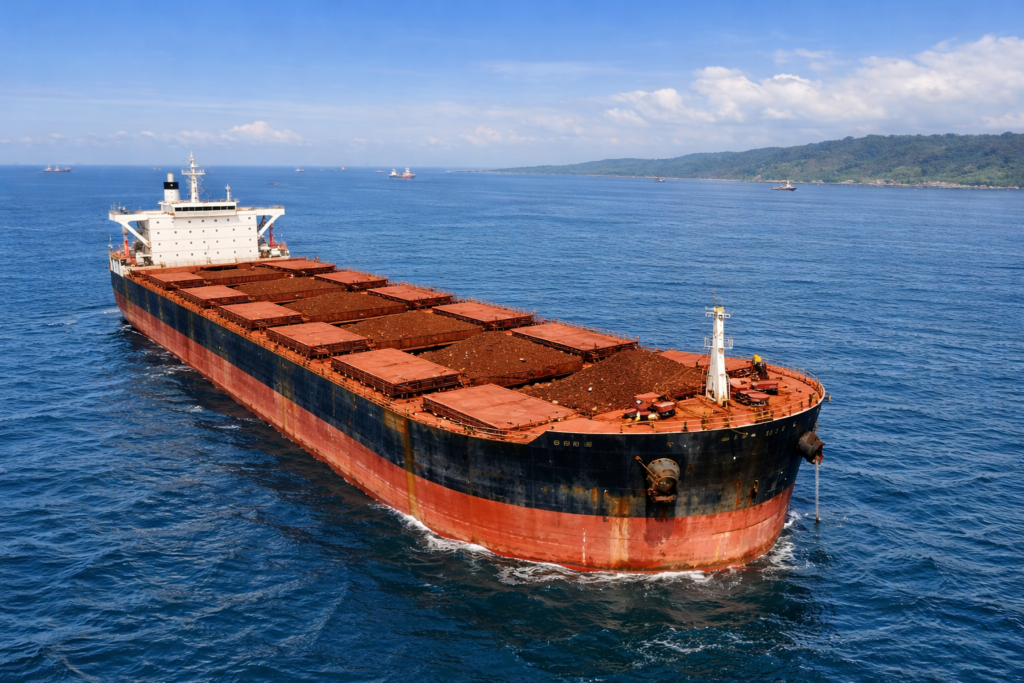
Offshore transshipment, also known as ship-to-ship (STS) transfer, involves transferring cargo between vessels at anchorage rather than at a conventional deep-water berth. In bulk cargo operations, this typically includes the use of floating cranes, self-propelled barges, tugboats, and coordinated marine teams.
For export operations, cargo may be loaded onto barges at a jetty using conveyor systems, then transported through designated navigation channels to anchorage, where it is transferred to a mother vessel. For import operations, the process may be reversed: cargo discharged from a bulk carrier into barges and transported to shore.
This offshore logistics model allows larger vessels to operate in regions where port depth would otherwise restrict direct access.
Addressing Port Draft Limitations
Draft limitations remain one of the most significant operational barriers for bulk shipping in parts of Central Africa. Capesize and Panamax vessels offer superior economies of scale, but they require deeper waters than many ports can provide.
By conducting cargo transfers offshore, operators can effectively bypass port draft constraints. Mother vessels remain safely at anchorage in suitable water depths while barges facilitate the final movement of cargo between shore and ship.
This method enhances trade capacity without requiring immediate large-scale infrastructure expansion, making it both cost-effective and operationally flexible.
Improving Operational Efficiency
Offshore transshipment contributes directly to improved logistics efficiency in several ways:
Reduced vessel waiting time: Offshore transfers can minimize berth congestion.
Optimized vessel utilization: Larger vessels can be deployed, lowering freight cost per ton.
Greater scheduling flexibility: Operations can be structured around anchorage conditions and cargo readiness.
Scalability: Barge-based systems allow gradual expansion as cargo volumes grow.
When properly planned and executed, ship-to-ship operations can significantly reduce demurrage exposure and enhance supply chain reliability.
Supporting Key Regional Industries
Bulk commodities play a central role in Central Africa’s economic development. Mining exports, cement production inputs, and construction materials rely on steady and predictable logistics chains.
Offshore marine logistics enables mining operators to maintain continuous export flows even in ports with physical constraints. Likewise, cement and infrastructure projects can sustain raw material supply through disciplined offshore discharge operations.
As commodity demand expands, the importance of structured marine logistics solutions increases proportionally.
Safety and Coordination in Offshore Operations
Offshore transshipment requires disciplined execution. Marine operations involve multiple assets operating in open-water conditions, including floating cranes, barges, tugboats, and mother vessels.
Safety protocols, crew training, weather monitoring, and regulatory compliance form the backbone of successful operations. Clear communication between ship masters, marine coordinators, and shore teams ensures cargo transfers are conducted safely and efficiently.
Operational discipline is essential. When safety, planning, and coordination align, offshore transshipment becomes not just an alternative — but an optimized logistics model.
Strengthening Regional Competitiveness
As Central Africa continues integrating into global trade networks, logistics performance will remain a defining factor in market access and cost competitiveness.
Offshore transshipment provides an adaptable and infrastructure-efficient method to handle growing bulk volumes without waiting for long-term port expansion projects. It bridges the gap between existing port capacity and future trade ambitions.
By enabling larger vessels, reducing delays, and improving cargo flow predictability, offshore marine logistics strengthens the region’s ability to compete in international commodity markets.
Conclusion
The evolution of marine logistics in Central Africa reflects broader global trends: larger vessels, higher cargo volumes, and the need for operational resilience.
Offshore transshipment offers a practical and disciplined response to structural port limitations. Through coordinated ship-to-ship operations, barge logistics, and marine asset deployment, regional trade can expand efficiently and sustainably.
As industrial growth accelerates, offshore marine logistics will remain a critical pillar supporting Central Africa’s bulk trade development and economic progress.
© Copyright 2026, cm2s.net. Developed by Deep-Tech Computing Private Limited, www.deeptechcomputing.com