Introduction: Port Performance Is Economic Performance
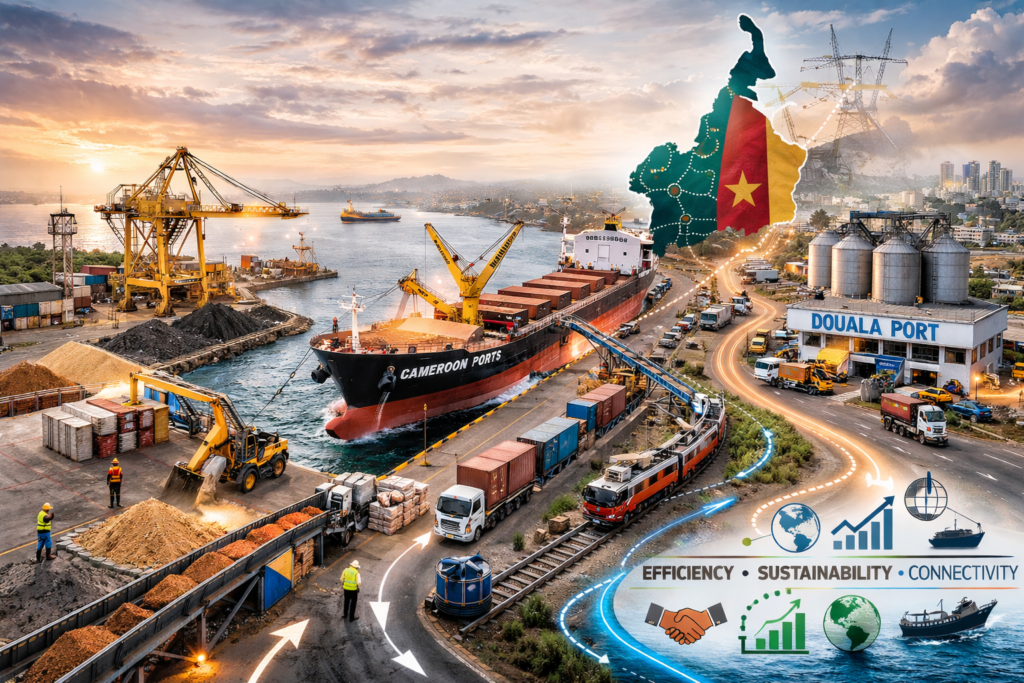
In today’s global economy, a country’s competitiveness is closely linked to the performance of its ports.
Speed, predictability, cost efficiency, and reliability are not operational details — they are macroeconomic drivers. For Cameroon, where maritime trade accounts for the vast majority of international commerce, the Port of Douala plays a central role in shaping national economic outcomes.
Improving port performance is not simply about moving ships faster. It is about strengthening supply chains, lowering costs for industry, attracting investment, and positioning Cameroon as a regional logistics leader in Central Africa.
What Defines Port Performance?
Port performance can be measured across several critical dimensions:
• Vessel turnaround time
• Cargo dwell time
• Berth productivity
• Channel accessibility
• Operational predictability
• Cost per ton handled
When these metrics improve, trade flows become smoother. When they stagnate, inefficiencies compound.
For exporters of bulk commodities such as bauxite, or importers of industrial raw materials like clinker and gypsum, even small inefficiencies increase costs and reduce competitiveness in global markets.
The Current Challenge: Constraints and Congestion
The Port of Douala faces structural constraints that influence performance:
• Draft limitations in the access channel
• Dependence on tidal windows for safe navigation
• Channel maintenance requirements
• Vessel size restrictions
• Occasional congestion during peak trade cycles
These challenges are not unique to Cameroon. Many river-access and estuary ports worldwide face similar limitations.
The key difference lies in how they respond.
Performance as a Strategic Lever
Improving port performance does not always require large-scale physical expansion. In many cases, operational reforms and logistics innovation deliver immediate gains.
Cameroon has already undertaken modernization efforts aimed at upgrading infrastructure and improving management systems. Building on these efforts requires a shift in mindset:
From reactive congestion management
→ to proactive performance optimization.
This includes:
• Coordinated vessel scheduling
• Enhanced communication between port authorities and operators
• Data-driven planning
• Integration of offshore operations
• Continuous monitoring of turnaround metrics
Performance becomes measurable, and therefore improvable.
The Role of Offshore and Parallel Operations
One of the most effective ways to increase throughput without overburdening channel infrastructure is to decentralize certain operations.
Offshore transshipment and parallel barge logistics allow:
• Large vessels to operate in deep water
• Simultaneous cargo handling offshore and onshore
• Reduced pressure on constrained inner channels
• Increased overall system flexibility
Rather than treating channel depth as a fixed bottleneck, performance-driven logistics treat it as a variable within a broader operational model.
This expands effective capacity without waiting for major civil works.
Economic Multiplier Effects
Improved port performance has ripple effects across the national economy.
Reduced waiting times and more efficient vessel handling decrease freight and demurrage costs. For cement producers and manufacturers, this lowers production costs.
Bulk exporters benefit from scale efficiencies when larger vessels can be handled effectively. This improves pricing competitiveness in international markets.
Industrial investors assess logistics reliability before committing capital. Efficient maritime systems reduce perceived operational risk.
Landlocked neighbors that rely on Douala benefit from faster, more predictable transit, strengthening Cameroon’s position as a regional trade corridor.
Digitalization and Data-Driven Operations
Modern port competitiveness increasingly depends on data.
Tracking:
• Vessel movements
• Barge rotations
• Cargo volumes
• Turnaround times
• Incident reports
enables continuous performance improvement.
Digital tools and operational dashboards allow decision-makers to identify bottlenecks early, adjust scheduling dynamically, and optimize asset utilization.
Performance management shifts from anecdotal to measurable.
For Cameroon, embracing data-driven maritime logistics is a strategic opportunity.
A Long-Term Vision for Cameroon’s Maritime Future
Cameroon’s geographic position in the Gulf of Guinea is a structural advantage. The challenge is converting that geographic advantage into operational superiority.
The long-term goal should be clear:
• Expand effective cargo capacity
• Reduce systemic delays
• Improve cost competitiveness
• Integrate offshore and onshore logistics
• Build a reputation for reliability
Port performance, when treated as a national asset, becomes a pillar of economic growth.
Conclusion: From Constraint to Competitive Strength
The Port of Douala will continue to serve as the backbone of Cameroon’s trade.
The question is not whether the port matters — it does.
The question is how its performance can evolve to meet growing industrial demand and rising export volumes.
By combining modernization, operational innovation, offshore logistics integration, and digital performance management, Cameroon can transform its maritime limitations into competitive strengths.
In global trade, efficiency wins.
And efficiency is built deliberately.
© Copyright 2026, cm2s.net. Developed by Deep-Tech Computing Private Limited, www.deeptechcomputing.com